You got that tattoo years ago. Maybe it was a name, a symbol that meant everything at the time, or just a youthful impulse on a college night out. Today, every time you glance at it, you feel the urge to cover it up with a sleeve or a bandage. If you have been searching for tattoo removal in Chennai and wondering whether it actually works, whether it will hurt, or whether it is safe for your skin you are in exactly the right place.
This guide answers every single question you have, written in plain, simple language that anyone can understand.
What Is Tattoo Removal and Why Do So Many People Want It?
A tattoo is made by injecting ink deep into the second layer of your skin, called the dermis. Think of the dermis as the skin underneath the skin you can touch. The ink particles sitting there are too large for your body’s immune system to break down and remove on its own which is exactly why a tattoo stays for a lifetime unless you actively do something about it.
Over the decades, tattoo removal has evolved dramatically. Old methods included dermabrasion (essentially sanding the skin’s surface raw), chemical peels, and surgical excision all of which left significant and permanent scarring. Today, laser tattoo removal in Chennai using advanced technology is the global gold standard, precisely because it can remove ink without destroying the surrounding skin tissue.
People choose to remove tattoos for many different reasons. Career changes and workplace appearance policies. A relationship that ended. A design that no longer reflects who they have become. Religious or personal beliefs that shifted after the tattoo was done. A wedding, photoshoot, or special occasion coming up. Or simply wanting clear, uninterrupted skin again. Whatever your reason, it is completely valid and today’s technology makes removal more achievable than ever before.
The Science — Simply Explained: Laser tattoo removal works on a principle called selective photothermolysis. In plain English, the laser sends a very fast burst of light that is absorbed specifically by ink pigment. This energy shatters the ink into tiny fragments, which are then gradually flushed away by your body’s immune system over the following weeks. The laser does not burn or cut your skin it selectively targets and breaks down ink only.
What Is the Fotona Laser and Why Is It Different?
Not all tattoo removal lasers are the same. The Fotona laser is a medical-grade, dual-wavelength laser system developed by Fotona a Slovenian company that has been a recognized leader in medical laser technology for over 60 years. Its tattoo removal system is used in dermatology clinics across Europe, the United States, and Asia, including at Elixify Skin Clinic in Chennai.
Here is the part most people searching for tattoo removal do not know: the color of tattoo ink determines which wavelength of laser light it absorbs. A single-wavelength laser can only effectively target certain ink colors. Fotona solves this problem with two wavelengths working together in one system:
1064 nm wavelength (Nd:YAG) penetrates deep into the skin and is highly effective for dark inks like black, dark blue, and dark green. This wavelength handles the majority of tattoos seen in India, where black ink is by far the most commonly used.
532 nm wavelength (KTP) targets brighter, more reflective colors like red, orange, yellow, and purple colors that older single-wavelength lasers genuinely struggle with and often leave partially untreated.
This dual-wavelength capability is what makes Fotona one of the most versatile tattoo removal systems available anywhere. It is especially important if you have a multi-colored tattoo with shading, gradients, or bright pigments that a simpler laser simply cannot address.
Who Is Fotona Tattoo Removal Right For?
Fotona tattoo removal at Elixify is designed for a wide range of people. You are likely a good candidate if any of the following situations describes where you are right now:
Career change or professional appearance requirements — Visible tattoos on the hands, neck, or forearms creating barriers in corporate environments, government roles, aviation, hospitality, or other appearance-conscious industries.
Name or relationship tattoos — A name, date, initials, or symbol from a relationship, friendship, or period of life you have moved on from and no longer want as a permanent reminder on your body.
A design you have simply outgrown — Tattoos done in the teen years or early twenties that have faded poorly, look dated, or no longer represent the person you have become.
Religious or cultural reasons — Personal or spiritual beliefs that have evolved since the tattoo was done, making the ink feel inconsistent with your current values.
Upcoming special occasions — Weddings, pre-wedding photoshoots, modelling assignments, or important life events where you want clear, unobstructed skin.
Cover-up preparation — Fading an existing tattoo before having a new design tattooed over it. A properly faded tattoo gives the new tattoo artist much more creative freedom and results in a far better cover-up outcome.
Important — Who Should Consult First: Fotona treatment is not recommended during pregnancy or breastfeeding. If you have a personal or family history of keloid scarring, active skin infection in the treatment area, or certain autoimmune skin conditions, a thorough medical consultation before starting treatment is essential. At Elixify, every patient undergoes a clinical screening before any laser treatment is recommended.
How the Fotona Tattoo Removal Process Works, Step by Step
Walking into a laser clinic can feel intimidating when you do not know what to expect. Here is exactly what happens during a Fotona tattoo removal session at Elixify, from your first visit all the way to the final result, in clear and simple language.
Step 1 — Free Consultation and Assessment Your first appointment is a detailed clinical consultation. The doctor examines your tattoo its size, location, colors, depth of ink, age, and how your skin type looks and responds. Based on this examination, a personalized treatment plan is created with a realistic timeline and honest expected outcome. No guesswork, no one-size-fits-all recommendations.
Step 2 — Skin Analysis and Patch Test For first-time patients especially those with sensitive or darker skin tones a patch test may be done on a small section of the tattoo. This simply means applying the laser to a tiny test area to observe how your skin responds before treating the full tattoo. It is a safety measure, not a cause for concern.
Step 3 — Preparing the Skin on Treatment Day The tattooed area is cleaned thoroughly. You are given protective eyewear to shield your eyes from the laser light. A topical numbing cream is then applied to the skin and left for 20 to 30 minutes, so by the time the laser begins, the area is comfortably numb.
Step 4 — The Laser Session The Fotona handpiece is passed over the tattooed area in precise, controlled pulses of light. The total time depends on the size of your tattoo — a small wrist tattoo may take 5 to 10 minutes, while a larger upper arm piece could take 20 to 35 minutes. Most people describe the sensation as a quick rubber-band snap on the skin. With numbing cream applied, the majority of patients find it very manageable.
Step 5 — Cooling and Immediate Aftercare Immediately after the laser, a cooling agent is applied to calm the skin and reduce redness and swelling. The treated area may appear slightly whitish right after the session this is called “frosting” and is a completely normal, temporary reaction showing the laser has worked on the ink.
Step 6 — Post-Treatment Instructions Before you leave, the doctor or clinic staff walk you through complete aftercare instructions what to apply, what to avoid, and when to return for your next session. These are also given to you in writing so there is no confusion.
How Many Sessions Will You Need? Understanding the Real Timeline
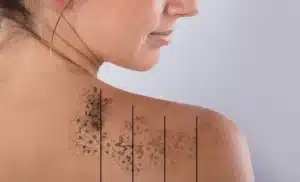
This is the first question almost every person asks and it deserves a completely honest answer rather than a vague “it depends.” It does depend, but here is a clear breakdown that gives you a realistic picture.
The number of sessions required for laser tattoo removal in Chennai is influenced by six key factors: your skin type, the tattoo’s location on your body, the colors of ink used, the total amount of ink deposited, whether any scarring is already present, and whether the tattoo is layered over a previous one.
Amateur or stick-and-poke tattoos — typically 3 to 5 sessions. Ink is deposited less deeply and in smaller quantities compared to professional work.
Professional black-ink tattoos — typically 5 to 8 sessions. Black ink absorbs laser energy most efficiently, but the volume of ink in a professional tattoo is significantly higher.
Multi-colored or bright tattoos — may require 6 to 10 sessions. Different colors absorb different wavelengths and may respond at different rates across sessions.
Old, faded tattoos — often respond faster 3 to 6 sessions because the ink has already started to naturally break down over years.
Cover-up tattoos (ink layered over previous ink) — the most complex category. Expect 8 to 12 sessions due to the double or triple density of ink in the skin.
Sessions are spaced 4 to 6 weeks apart. This spacing is not arbitrary your body needs time to process and flush out the shattered ink particles through the lymphatic system. Rushing the intervals does not speed up results and can actually reduce effectiveness while increasing the risk of skin irritation.
The most important advice: The biggest reason people do not see complete removal is inconsistency. Patients who attend every scheduled session and follow aftercare instructions diligently tend to see significantly better and faster results than those who skip sessions or delay follow-ups without reason. Think of each session as compounding progress every visit builds on the last.
Is Fotona Tattoo Removal Painful? The Truth About Comfort
This is genuinely one of the most searched questions when people look up painless tattoo removal in Chennai and it deserves a truthful, balanced answer rather than either exaggeration or false comfort.
Laser tattoo removal is not completely painless. That would be misleading to say. However, Fotona is significantly more comfortable than older laser systems and dramatically more comfortable than older non-laser removal methods like dermabrasion or excision.
The sensation is most commonly described by patients as similar to a rubber band being snapped quickly against the skin, or a light stinging sensation. The speed of the Fotona pulse is extremely fast measured in nanoseconds which means the skin experiences the energy impact without prolonged heat building up in the tissue. This is what makes the recovery faster and the session experience more manageable.
At Elixify Skin Clinic in Chennai, a topical numbing cream is applied 20 to 30 minutes before every single session. By the time the laser begins, the treated area is comfortably numb for the vast majority of patients. People who arrive nervous before their first session almost universally report that it was much easier than they had anticipated.
Is It Safe for Indian Skin Tones? A Critical Question
This is where Fotona’s precision becomes especially important and where choosing the right clinic makes a real clinical difference.
India has a wide range of skin tones, classified on the dermatological Fitzpatrick scale from Type I (very fair, burns easily) to Type VI (deep brown, never burns). Most Chennai residents fall in the Type III to V range. Darker skin tones contain more melanin the natural pigment in skin which can sometimes absorb laser energy if the settings are not carefully calibrated. This is what can cause temporary darkening (hyperpigmentation) or lightening (hypopigmentation) of the skin after laser treatment when performed incorrectly.
Here is where most people get it wrong they assume that any laser works on any skin tone with the same settings. That assumption is precisely what causes adverse outcomes and the scarring stories you may have heard about.
Fotona’s system allows the dermatologist to precisely calibrate the wavelength, pulse duration, and energy level for your specific skin tone. At Elixify, every patient undergoes a clinical skin tone assessment before the first session, and settings are optimized accordingly. The 1064 nm wavelength is particularly well-suited for South Indian skin because it penetrates deeply into the dermis while being absorbed significantly less by surface melanin compared to shorter-wavelength lasers. This makes it one of the genuinely safer options for darker skin tones in South India.
Can Colored Tattoos Really Be Removed? The Full Truth
For years, people with colorful tattoos were told that laser removal only worked effectively on black ink. That information is outdated. Fotona’s dual-wavelength technology makes colored tattoo removal in Chennai a genuinely achievable outcome though some colors respond more readily than others, and it is important to set honest expectations.
Here is a straightforward color-by-color breakdown:
Black and dark grey ink — The easiest to remove. Black ink absorbs the 1064 nm wavelength very efficiently. Most black tattoos see rapid, visible fading per session.
Dark blue and dark green ink — Also respond well to the 1064 nm wavelength. Usually clear with the same number of sessions as black ink.
Red and orange ink — Targeted effectively with the 532 nm wavelength. Generally respond well across multiple sessions.
Purple and violet ink — Require a combination of both wavelengths. Response is moderate and may need a couple of additional sessions compared to black ink.
Yellow and light green ink — These lighter, reflective colors are the most challenging across all laser systems globally, not just Fotona. They require the 532 nm wavelength and often need more sessions to achieve significant fading.
White and skin-colored ink — The most unpredictable category. White ink sometimes paradoxically darkens when hit by laser energy before gradually fading. Specialized settings and a patch test are essential for this ink type.
The important point to understand is that no responsible clinic can guarantee 100% clearance of every color in a fixed number of sessions results genuinely vary by individual tattoo and skin. What Fotona offers is the best available technology to address the broadest spectrum of colors with greater precision than older single-wavelength systems.
Aftercare After Fotona Tattoo Removal, What You Must Follow
Aftercare is not a minor footnote it is an essential part of the treatment. How you care for your skin in the days following each session directly affects both how fast you heal and how good your final results are. The Elixify team provides every patient with personalized written instructions, but here are the universal guidelines that apply to everyone:
- Keep the treated area clean. Gently wash with mild soap and cool water. Pat dry with a clean cloth never rub the area aggressively.
- Apply the prescribed healing ointment or cream exactly as directed. Do not substitute with home remedies, turmeric, aloe vera gel, or any product the clinic has not approved for the treated area.
- Avoid direct sun exposure on the treated area for at least 4 weeks after each session. Sun exposure can cause significant pigmentation changes on recently lasered skin. When you must go outdoors, use SPF 50+ broad-spectrum sunscreen on the area once it has healed enough to tolerate it.
- Do not swim, use a hot tub, or soak the treated area in water for at least 48 hours after treatment. Chlorine and prolonged water exposure can irritate healing skin.
- Skip the gym for 24 hours. Sweating heavily can cause unnecessary irritation to the treated skin during the initial healing window.
- Do not pick, scratch, or peel any blistering or scabbing that may form. Blistering is a normal sign that the body is healing. Interfering with it mechanically is the primary cause of scarring from laser tattoo removal.
- Stay well hydrated. Drinking adequate water genuinely helps your lymphatic system the body’s waste disposal network flush out the broken-down ink particles more efficiently.
- Attend your follow-up sessions on schedule. Extending gaps beyond the recommended 4 to 6 weeks between sessions does not cause harm, but it slows down your overall progress considerably.
Mild redness, slight swelling, and a feeling of warmth in the treated area are completely normal for the first 2 to 3 days after each session. If you notice anything beyond this persistent pain after the third day, yellow or green discharge, or fever contact the clinic immediately.
What Results Can You Realistically Expect?
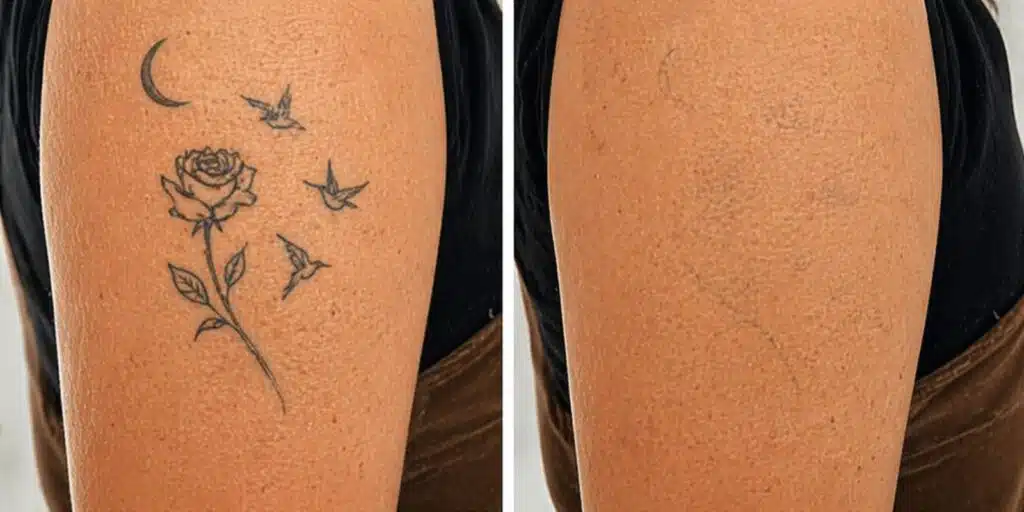
Let’s be completely honest about expectations because managing them properly is a big part of what makes the experience positive rather than disappointing.
After your first session, you will likely notice some initial fading the tattoo looks slightly lighter than before. You will not see dramatic results yet, and that is perfectly normal. The laser has done its job; your body now needs 4 to 6 weeks to flush out the broken-down ink particles. The real visible change happens progressively across multiple sessions.
By sessions 3 and 4, most patients with black or dark tattoos start seeing significant, clearly visible fading often 50% or more reduction in ink darkness and clarity is common at this stage. Multi-colored or heavily saturated tattoos take longer to show this level of progress.
By the final recommended sessions, the majority of patients achieve either complete clearance (no visible tattoo ink remaining when examined in normal light) or near-complete clearance, where only a very faint shadow of the original tattoo remains.
A smaller subset of tattoos particularly those with white or fluorescent ink, those placed over previous tattoos, or those with unusually dense ink deposits may not achieve complete 100% clearance even with the optimal number of sessions. In these cases, the treatment goal shifts to maximum fading to the point where the tattoo is no longer clearly visible from a conversational distance.
Factors that consistently lead to better outcomes include: not smoking (smoking impairs circulation and slows immune clearance of ink particles), staying well hydrated, keeping the follow-up sessions on schedule, protecting the treated area from sun exposure between sessions, and following every aftercare instruction without shortcuts.
Why the Right Clinic Matters More Than You Think
Searching for best tattoo removal in Chennai returns many results, and price is often the first thing people compare. Before making that decision purely on cost, here is what actually matters from a clinical standpoint.
The laser technology genuinely differs. There is a real and significant difference between a certified Fotona machine engineered to medical specifications with precise wavelength control and a generic or unbranded “laser device” being used at a lower-cost facility. The difference shows up directly in outcomes and in the risk profile for your skin.
Who is operating the laser matters enormously. Calibrating laser settings for different skin tones, tattoo depths, and ink colors is a medical skill, not just a technical button-press. At Elixify, every treatment plan is designed and supervised by a qualified dermatologist who has assessed your specific skin type and tattoo characteristics.
Cheap upfront cost can become expensive. Using an improperly calibrated or inferior laser on skin especially on darker Indian skin tones can cause hyperpigmentation, blistering, or scarring. Treating those complications costs significantly more than the savings made on the original cheaper session. This is the single most important reason to choose a medically supervised clinic with verified equipment.
Transparency about realistic outcomes. A trustworthy clinic will never promise you complete removal in a fixed number of sessions regardless of your tattoo’s characteristics. What Elixify commits to is a personalized, honest assessment and the best available technology to achieve the maximum possible outcome for your specific case.
What Does Tattoo Removal Cost in Chennai?
The cost of tattoo removal in Chennai varies based on several honest factors: the physical size of the tattoo, the number of different ink colors present, the total number of sessions your tattoo realistically requires, and the level of technology and medical oversight at the clinic.
As a general reference point, clinics using basic single-wavelength Q-switch lasers typically charge less per session. Clinics using advanced dual-wavelength systems like Fotona charge a higher per-session fee but often achieve better clearance per session which can reduce the total number of sessions needed, sometimes making the overall cost across your full treatment course comparable.
The consultation at Elixify Skin Clinic Chennai is free, and you receive a transparent, personalized cost estimate during that session based on a proper assessment of your tattoo not a generic price list. There are no hidden session charges or surprise add-ons.
Frequently Asked Questions
How many sessions does Fotona tattoo removal take? Most tattoos require between 4 and 8 sessions, spaced 4 to 6 weeks apart. Simpler, older, or single-color black tattoos may need fewer. Multi-colored or cover-up tattoos may need more. Your doctor at Elixify will give you a personalized estimate during the consultation after examining your specific tattoo not a generic number pulled from a brochure.
Is laser tattoo removal painful? Fotona is one of the more comfortable tattoo removal systems available. The ultra-fast pulse duration minimizes heat discomfort. At Elixify, a numbing cream is applied before every session. Most patients describe the feeling as a mild snapping sensation noticeably more comfortable than older laser systems and far more manageable than older non-laser removal methods.
Can Fotona remove colored tattoos completely? Yes, it is designed to do so. Fotona’s dual-wavelength system targets both dark inks and bright colors including red, orange, and yellow. Most colored tattoos can be faded significantly or fully cleared, though lighter colors like yellow and white may require more sessions than black ink.
Is laser tattoo removal safe for my Indian skin tone? Yes, when performed by a qualified dermatologist using the right settings. Fotona’s 1064 nm wavelength is specifically well-suited for Indian and South Asian skin tones because it penetrates deeply while being absorbed less by surface melanin. At Elixify, all laser settings are customized after a thorough Fitzpatrick scale skin tone assessment.
Will tattoo removal leave a scar? When performed correctly on appropriate skin types with properly calibrated settings, Fotona laser tattoo removal has a very low scarring risk. Scarring is more likely when aftercare instructions are not followed, when sessions are performed too frequently without adequate healing time between them, or when inadequate equipment is used. Choosing an experienced, medically supervised clinic is the most effective way to minimize this risk.
Can old tattoos be completely removed? In many cases, yes. Older tattoos where the ink has naturally degraded or faded over time often respond very well to laser treatment. The body has already started breaking down some of the ink naturally, meaning the laser has less total ink to address. Consistent sessions with proper aftercare typically lead to significant or complete clearance.
What is the downtime after each session? Minimal. Mild redness or slight swelling for 2 to 3 days is normal. Most patients return to normal daily activities the same day. You are advised to avoid intense sun exposure, swimming, and heavy exercise for 24 to 48 hours after each session.
What is the cost of tattoo removal at Elixify Chennai? The cost depends on your tattoo’s size, number of colors, and the sessions required for your specific case. The consultation at Elixify is free, and you receive a transparent cost breakdown during that visit — call +91 93840 66702 or visit elixify.in to schedule yours.
The Bottom Line
Tattoos are permanent — until they aren’t. Modern laser technology has genuinely made it possible for people to change their skin story, whether that means completely erasing an old tattoo or fading it enough to prepare for a new design.
If you have been searching for tattoo removal in Chennai and feeling overwhelmed by the information and options available, here is the simplest summary worth remembering: choose a clinic that uses verified, medical-grade laser technology like Fotona. Choose a clinic where a qualified doctor designs your treatment plan rather than just a technician operating a machine. Follow your aftercare instructions diligently between every session. And be patient with the process — results build session by session, and the outcome for most people is well worth the commitment.
At Elixify Skin Clinic in Chennai, the approach to tattoo removal starts with understanding your skin, your tattoo, and your goal — then building a personalized plan designed to get you there as safely and effectively as current technology allows.